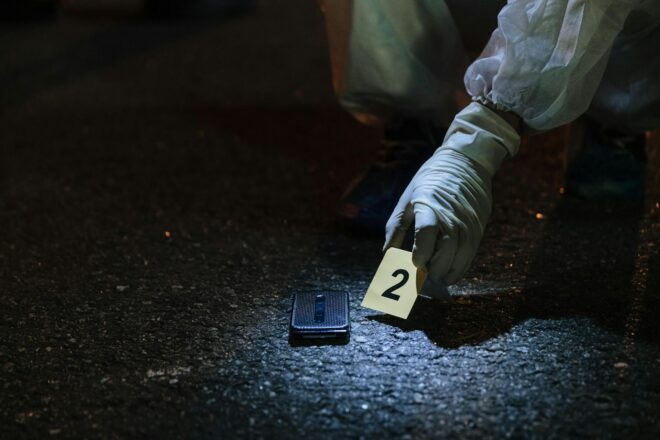
Many criminal charges such as first-degree murder, second-degree murder, third degree murder, and manslaughter hinge on a single piece of evidence, such as a fingerprint, a DNA sample, or weapons such as guns that involve ammunition as evidence. How bits of evidence such as bullet casings and DNA swabs are collected and contained is just as important to your case as the item itself. What many people facing the criminal justice system don’t realize is that evidence is only valid if it’s handled properly from start to finish. If the chain of custody is broken, it can lead to a case that falls apart upon closer inspection.
In a criminal case, the chain of custody refers to the documented trail that shows who collected, handled, transferred, analyzed, and stored physical evidence. It ensures that the evidence presented in court is the same item that was originally collected at the scene and that it hasn’t been tampered with, lost, or contaminated.
For a free legal consultation, call (844) 283-2648
If any part of this documentation is missing or unclear, it opens the door for the defense to argue that the evidence is unreliable and therefore inadmissible to a court case. Evidence can be inadmissible if it is unreliable or obtained illegally. Only evidence that has a clear chain of custody is considered legally admissible in court.
Even one of these mistakes can cast doubt on whether the evidence being used belongs in the criminal case. This is why skilled defense attorneys review the chain of custody records early in a case; they know that small procedural errors can lead to major wins for the defense.
When something goes amiss, it can jeopardize the prosecution’s case. Mistakes happen, and when they do, those instances of doubt can turn the tide. Compromised chain of custody procedures have led to thousands of overturned convictions after it was discovered that evidence was mishandled or falsified.
During discovery, defense counsel reviews evidence logs, chain forms, and property receipts to find inconsistencies. If any are found, they can file a Motion to Suppress Evidence. The rationale for this is that the prosecution cannot prove that the item is legit, belongs to the same case, or wasn’t tampered with.
Once the judge receives the Motion to Suppress Evidence, they review the chain of custody and determine whether the irregularities leave opening enough for evidence manipulation. If there is another method of verifying authenticity of the evidence, the judge may retain the case evidence upon verification. At this point, the defense can still use the discrepancies to challenge case credibility during cross-examination or to sway jury perception by injecting reasonable doubt into their minds.
However, if the judge feels that the mishandling of evidence shows that the evidence cannot be trusted to be accurate, it may be excluded or thrown out of the case. If mishandled evidence is thrown out, the suppressed evidence would never make it into the courtroom, and a jury would never know of its existence.
Losing that lynchpin item may make the prosecution abandon their strategies and rely more heavily on other aspects of the case, which may not be as damning. In criminal cases where the suppressed evidence is a crucial item to determining guilt, like DNA, a gun, or narcotics, its absence can lead to the case being dismissed entirely.
A broken chain of custody could mean the difference between conviction and freedom. If you suspect evidence in your case was mishandled, you should speak to a criminal defense lawyer immediately to find out about your options.
To learn more about how evidence can impact your case, read more at:
Are you or a loved one charged with a felony offense such as Homicide? Schedule your free consultation with our proven criminal defense attorneys at the Law Offices of M.J. Snyder, LLC by calling (844) 283-2648 or contacting us online today. We can thoroughly investigate your case, explain your options, and fight for the best possible outcome.